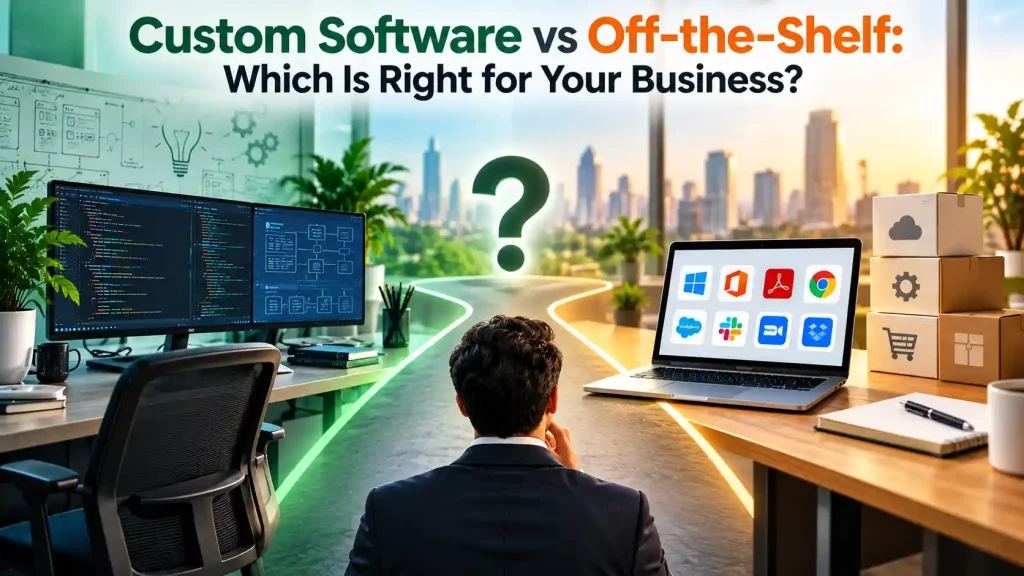
Every software decision eventually comes down to a build-vs-buy question. Do you subscribe to an existing tool Salesforce, Shopify, QuickBooks or invest in something built specifically for your business?
Neither option is universally “better.” The right answer depends on how standard your workflow is, how much you’re willing to invest, and how much control you need. This guide breaks down custom software vs off-the-shelf software across every factor that actually matters, so you can make the decision with confidence.
For a broader overview of custom software types, costs, and development processes, see our Custom Software Development: Complete Guide for Business Owners.
What’s the Difference?
Off-the-shelf software is a pre-built product designed to serve many businesses at once – think Shopify, Salesforce, QuickBooks, or Zoho. You sign up, configure some settings, and adapt your workflow to fit what the software offers.
Custom software (also called bespoke software) is built from scratch specifically for your business. Every feature, workflow, and integration is designed around how you actually operate – not the other way around.
Neither is inherently superior. A Fortune 500 company and a two-person startup have very different needs, and the right choice depends entirely on your specific situation.
Custom Software vs Off-the-Shelf: Full Comparison
| Factor | Off-the-Shelf | Custom Software |
| Upfront Cost | Low – monthly/annual subscription | High – one-time development investment |
| Long-Term Cost | Recurring, scales with users/usage | One-time + optional maintenance (often lower over 3-5 years) |
| Time to Launch | Immediate sign up and go | Weeks to months depending on scope |
| Fit to Your Workflow | You adapt to the software | The software adapts to you |
| Ownership | Vendor owns the platform and your data location | You own the code and control your data |
| Customization | Limited to what the vendor allows | Unlimited build exactly what you need |
| Scalability | Bound by vendor’s pricing tiers and limits | Scales however your business requires |
| Integration Flexibility | Limited to vendor’s available integrations | Connect to any system you need |
| Vendor Lock-In | High switching platforms means migrating everything | None – you control the roadmap |
| Support | Vendor’s support queue, shared across all customers | Dedicated support from your development team |
For real pricing numbers behind the “custom software” column, see our detailed breakdown: How Much Does Custom Software Development Cost?.
When Should You Choose Off-the-Shelf or Custom Software?
The right choice depends on your workflow, budget, speed, and how much control your business needs. Here’s when each option makes sense.
When Off-the-Shelf Is the Right Choice
Off-the-shelf software is the smarter choice when:
- Your workflow is standard. Email, basic accounting, project management thousands of businesses have the exact same needs, and mature products already solve them well.
- You need to move fast. You can sign up today and be running by tomorrow. Custom software takes weeks to months to build.
- Your budget is limited. A subscription costing a few thousand rupees a month is far more accessible than a six-figure development investment.
- You’re still validating your business model. Early-stage businesses benefit from cheap, flexible tools before committing capital to custom infrastructure.
- The category has mature, well-built options. Some categories (email marketing, accounting, HR) have excellent off-the-shelf products refined over a decade – rebuilding them rarely makes sense.
When Custom Software Is the Right Choice
Custom development is worth the investment when:
- Your workflow is genuinely unique. No existing product fits without heavy, awkward workarounds that slow your team down every day.
- You’re building a product, not just using a tool. A SaaS platform, a marketplace, a fintech app – if the software IS your business, it has to be custom-built.
- You need deep integrations. Connecting multiple systems (CRM + ERP + payment gateway + inventory) natively, instead of duct-taping third-party integrations together.
- Data ownership and security matter. Regulated industries, sensitive customer data, or compliance requirements often demand full control over infrastructure.
- You’ve outgrown off-the-shelf limits. You’re hitting user caps, feature ceilings, or paying enterprise-tier prices for a subscription that still doesn’t fully fit.
- You want a competitive advantage. Your competitors use the same template everyone else does. Custom software lets you move faster and differentiate.
Think your business needs something built specifically for it? Explore our custom software development services.
Special Case: SaaS vs Custom Development
This question comes up often for businesses considering a subscription-based SaaS tool versus building their own custom platform. The distinction is important:
If you’re a business using a SaaS tool (like using Shopify for your online store), off-the-shelf makes sense for most standard retail needs. But if you’re a business building a SaaS product – your own subscription platform sold to other companies – that product itself has to be custom-built, because it’s the core asset of your business.
If you’re building a SaaS product, read our dedicated guide: How to Build a SaaS Product from Scratch: Step-by-Step Guide.
The Hybrid Approach: Best of Both Worlds
Many businesses don’t have to choose one path exclusively. A common and effective strategy is a hybrid approach:
- Use off-the-shelf tools for standard functions – accounting, email, basic HR
- Build custom software for your core, differentiating workflow – the system that actually runs your unique business process
- Integrate the two so data flows automatically between them, rather than manual re-entry
This lets you avoid reinventing solved problems while still investing custom development budget where it actually creates competitive advantage.
A Simple Decision Framework
Ask yourself these questions in order:
- Does a mature product already solve this well? If yes, and your workflow is standard, go off-the-shelf.
- Is this software core to my competitive advantage? If yes, custom is usually worth it, even if it costs more upfront.
- Am I hitting real limitations with my current tools? User caps, missing features, awkward workarounds – if these are costing you time and money daily, custom pays for itself.
- Can I afford the upfront investment? If not yet, start with off-the-shelf and revisit custom once you have validated demand and available budget.
Once you’ve decided custom is the right path, choosing the right development partner matters as much as the decision itself – see our guide: Software House in Karachi: How to Choose the Right Partner.
Frequently Asked Questions
Is custom software always more expensive than off-the-shelf?
Upfront, yes, custom development requires a larger initial investment than a subscription. But over 3-5 years, custom software can be cheaper than an off-the-shelf subscription that scales its price with your user count or usage, especially for growing businesses.
Can I switch from off-the-shelf to custom software later?
Yes, and many businesses do exactly this. Start with off-the-shelf tools to validate your business model, then invest in custom software once you understand your exact requirements and have outgrown the limitations of generic tools.
What is “build vs buy” and how do I decide?
“Build vs buy” is the standard framework for this decision: buy (off-the-shelf) when your need is common and solved well already; build (custom) when your need is unique, core to your competitive advantage, or when existing tools create real limitations. Most businesses do both for different parts of their operations.
Is SaaS the same as custom software?
No. SaaS refers to how software is delivered (as a subscription, over the internet) it can be either off-the-shelf (a generic SaaS product like Shopify) or custom-built (a SaaS platform you build and own as your own product).
What are the risks of custom software development?
The main risks are choosing the wrong development partner, unclear requirements leading to scope creep, and higher upfront cost with no guarantee of ROI if the project isn’t scoped correctly. These risks are managed by working with an experienced team, defining a clear MVP, and using a structured, milestone-based development process.
Not Sure Which Path Is Right? Ask JZARR Tech
JZARR Tech helps businesses make this decision honestly, including telling you when off-the-shelf is genuinely the better fit. When custom development is the right call, our team handles it end to end: architecture, design, development, and post-launch support, with 100% in-house engineering.
Book your free consultation today and get an honest recommendation for your specific situation no pressure, no obligation.