Building a SaaS product software you sell to customers as a subscription is a fundamentally different exercise from building internal business tools. You’re not just solving your own problem; you’re building something other people will pay for, rely on, and expect to keep improving.
This guide walks through the entire process step by step: validating the idea, scoping an MVP, choosing the right technology, pricing the product, and what it realistically costs to get from concept to launch.
If you’re still deciding whether custom development is the right path at all, our broader guide – Custom Software Development: Complete Guide for Business Owners – is a good starting point before diving into SaaS specifics.
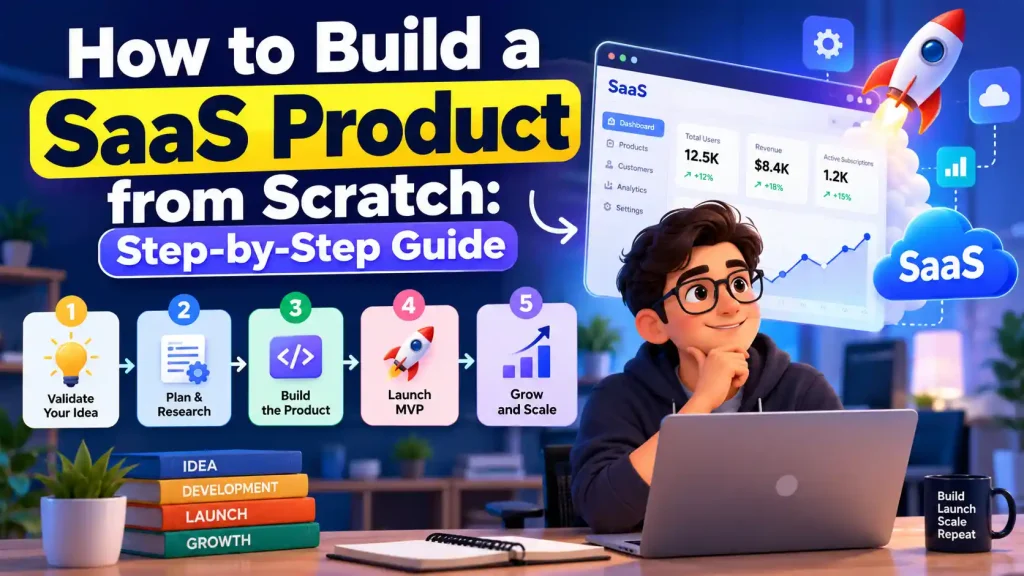
How to Build a SaaS Product Step by Step
Building a SaaS product requires more than coding. You need to validate demand, define the MVP, choose the right technology, set pricing, and build in stages.
Step 1: Validate the Idea Before Writing Any Code
The biggest risk in SaaS isn’t technical – it’s building something nobody wants to pay for. Before any development starts, validate the idea:
- Talk to potential customers directly. Not surveys – actual conversations about their current workflow, pain points, and what they’re already paying to solve this problem.
- Check if people are solving this problem manually. Spreadsheets, workarounds, and hacky combinations of other tools are strong signals of real demand.
- Look at existing competitors, even imperfect ones. Competitors validate the market exists. The opportunity is usually in what they do poorly.
- Get a handful of people to commit before you build. A waitlist, a pre-order, or even a verbal “I’d pay for this” from 10+ target users is worth more than assumptions.
Step 2: Define Your MVP Scope
An MVP (Minimum Viable Product) includes only the features required to solve the core problem for your first users – nothing else. This is the single biggest lever for controlling cost and time to launch.
What Belongs in an MVP
- The one core workflow that solves the primary problem
- Basic user authentication (sign up, log in, password reset)
- A simple, functional interface – polish comes later
- Payment/subscription handling if you’re charging from day one
What to Leave Out of an MVP
- Advanced customization and settings
- Multiple user roles and permission levels (unless core to the product)
- Integrations with third-party tools beyond the essential one
- Analytics dashboards and reporting features
- Mobile apps – a responsive web app is usually enough to start
For context on why scope is the biggest cost driver in any custom build, see our pricing breakdown: How Much Does Custom Software Development Cost?.
Step 3: Choose the Right Technology Stack
SaaS products have specific technical requirements beyond a typical website – multi-tenancy (serving many customers from one system), subscription billing, and infrastructure that scales as users grow.
| Layer | Common Choice | Why |
| Frontend | React, Next.js | Fast, interactive interface for your product |
| Backend | Node.js (NestJS), Python (FastAPI/Django) | Handles business logic, APIs, and user data |
| Database | PostgreSQL | Reliable, scalable, well-suited to multi-tenant data |
| Authentication | Auth0, custom JWT-based auth | Secure sign-up, login, and session management |
| Payments/Billing | Stripe, Paddle | Subscription billing, invoicing, and payment handling |
| Hosting | AWS, Google Cloud, Vercel | Scalable infrastructure that grows with your user base |
Multi-tenancy – the architecture that lets one system serve many separate customer accounts securely – is the piece that most differentiates SaaS development from a typical business application. Get this decided early, since retrofitting it later is expensive.
If you’re comparing custom development with ready-made software before committing to a SaaS build, see our guide on Custom Software vs Off-the-Shelf: Which Is Right for Your Business?.
Step 4: Decide on a Pricing Model
How you price your SaaS product affects both revenue and the features you need to build (usage tracking, tiered access, billing logic). Common models:
- Flat subscription – one price, full access. Simplest to build and understand.
- Tiered pricing – multiple plans (Basic, Pro, Enterprise) with different feature access. Requires feature-gating logic.
- Usage-based pricing – customers pay based on consumption (API calls, storage, seats). Requires usage tracking infrastructure.
- Freemium – free tier with paid upgrades. Effective for growth, but adds complexity in managing free-tier limits.
For most first-time SaaS builders, a simple flat or two-tier pricing model is the right starting point – usage-based and freemium models add real engineering complexity that’s easier to justify once you have paying customers and real usage data.
Step 5: Build in Sprints, Not One Big Launch
SaaS products should be built iteratively: an agile, sprint-based process where you see working software every two weeks, not a single reveal after months of silence.
- Design and prototype the core workflow first. Validate the user experience before writing production code.
- Build the MVP feature set in 2-week sprints. Each sprint should produce something you can actually test.
- Launch to a small group of early users first. A soft launch surfaces real bugs and usability issues before a wider release.
- Iterate based on real usage, not assumptions. Early user behavior will contradict some of your original assumptions – that’s expected and valuable.
What Does It Cost to Build a SaaS Product?
| Stage | Cost (PKR) | Cost (USD) | Timeline |
| MVP (core workflow only) | 1,000,000 – 3,000,000 | $4,000 – $12,000 | 3 – 5 months |
| Full Product (multiple features, polish) | 3,000,000 – 10,000,000+ | $12,000 – $40,000+ | 6 – 12 months |
| Ongoing Development (post-launch) | Varies | Typically 15-20% of build cost annually | Ongoing |
Ready to scope your SaaS MVP properly before committing budget? Our custom software development services team can help define exactly what to build first.
Choosing a Development Partner for Your SaaS Product
SaaS development requires a team comfortable with subscription billing, multi-tenant architecture, and ongoing iteration – not just a one-off project delivery mindset. Our evaluation guide, Software House in Karachi: How to Choose the Right Partner, covers what to check before committing – all of it applies here, with extra weight on post-launch support since SaaS products need continuous development, not a single delivery.
Frequently Asked Questions
How long does it take to build a SaaS MVP?
A focused SaaS MVP typically takes 3-5 months from discovery to launch, depending on complexity. Rushing this timeline usually means cutting corners on testing or scope discipline, which creates problems post-launch.
How much does it cost to build a SaaS product?
An MVP typically costs PKR 1,000,000-3,000,000 ($4,000-$12,000). A full-featured product with polish and additional functionality can range from PKR 3,000,000-10,000,000+ ($12,000-$40,000+), depending on scope.
Do I need to validate my SaaS idea before building it?
Yes, this is the single most important step and the one most often skipped. Talking to potential customers, checking for existing demand, and getting commitments before building dramatically reduces the risk of building something nobody wants to pay for.
What is multi-tenancy and do I need it?
Multi-tenancy is the architecture that lets one system securely serve many separate customer accounts from shared infrastructure. If you’re building a SaaS product sold to multiple customers, you need it – retrofitting it after launch is significantly more expensive than building it in from the start.
Should I build a mobile app alongside my SaaS product?
Not initially. Most SaaS MVPs launch as a responsive web application, which works across desktop and mobile browsers. A dedicated mobile app is worth considering only after you’ve validated demand and have the budget to support a second platform.
Build Your SaaS Product with JZARR Tech
From MVP scoping to full product development and ongoing iteration, JZARR Tech builds SaaS platforms with proper multi-tenant architecture, subscription billing, and scalable infrastructure from day one – not retrofitted after the fact.
Book your free consultation today and get a clear MVP scope, timeline, and cost estimate for your SaaS idea.